 SN Chemical Industries Ltd.
SN-100-PCSS
Penetrating concrete surface densifier and treatment for compatible cementitious substrates.
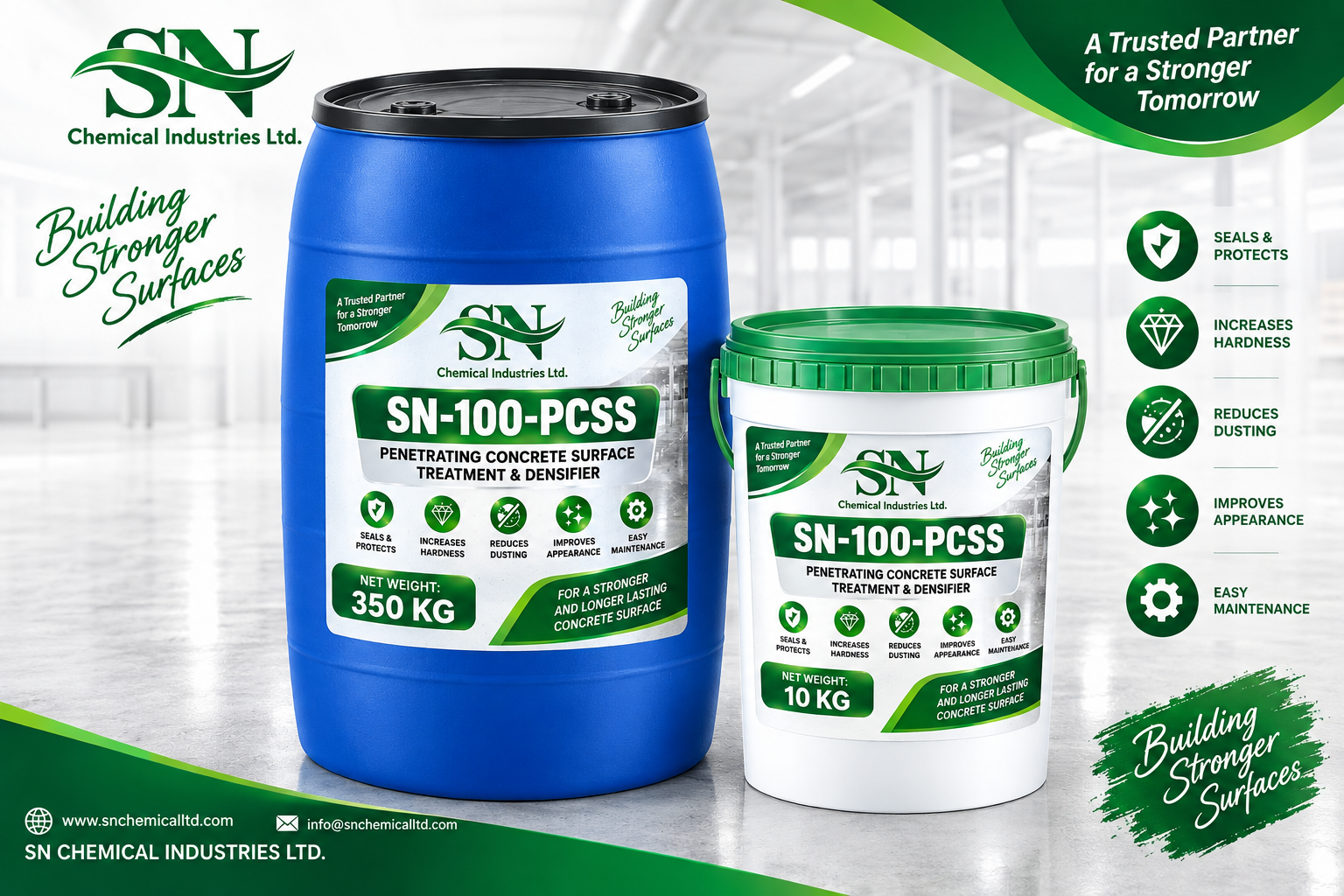
SN-100-PCSS — Full Technical Details
1. Product Description What it is⌄
SN-100-PCSS is a liquid penetrating treatment developed for concrete surfaces where densification and treatment of the cementitious substrate are required. Unlike conventional film-forming coatings, it is intended to penetrate into the concrete rather than create a membrane on the surface. Correct application allows the material to be absorbed into the substrate and provides an integral surface treatment.
The product may be used on freshly finished concrete and, subject to suitable assessment and preparation, on selected existing concrete. It may also be applied to exterior concrete, vertical concrete and casting-bed applications.
2. Product Features Key characteristics⌄
- Penetrating, non-membrane treatment for concrete surfaces.
- Suitable for freshly finished and exterior concrete.
- Applicable to selected existing and vertical concrete surfaces.
- Suitable for selected casting-bed and tilt-wall applications.
- Designed for application by low-pressure, high-volume spraying.
- Water-assisted finishing and residue-removal procedure.
3. Recommended Uses Where to use⌄
- Industrial, warehouse and factory floors.
- Commercial concrete slabs.
- Freshly placed and finished concrete.
- Exterior concrete areas.
- Concrete casting beds and tilt-wall construction.
- Vertical concrete surfaces and other compatible cementitious substrates.
4. Application on Freshly Finished Concrete Fresh slabs⌄
Surface Condition
When SN-100-PCSS is applied immediately following final concrete finishing, extensive mechanical preparation is generally not required. The slab should be sufficiently firm to allow safe access without damaging the finished surface.
Where formwork has recently been removed, ensure that form oils, release agents, bond-breaking compounds and similar contaminants are completely removed. Residual materials may restrict penetration.
Initial Application
As soon as the finished slab can safely accept foot traffic, apply SN-100-PCSS uniformly using a low-pressure, high-volume sprayer. Typical application rate is approximately 20–24 m²/kg, depending on concrete porosity and surface condition.
The material may also be distributed directly onto the floor and spread evenly with a clean, soft-bristled broom. Apply enough product for the concrete to remain thoroughly wetted while absorption takes place.
Maintaining the Wet Surface
Maintain a continuous wet layer across the treated area. Lightly work the material with a soft-bristled broom to encourage uniform distribution and penetration. Keep the surface continuously wet for approximately 30 minutes. Do not allow isolated areas to dry prematurely.
Porous locations and slab edges may absorb material faster. Redistribute product from wetter sections or apply additional SN-100-PCSS where necessary. Cool, still weather may extend the working period, while hot or drying conditions may require additional material.
Water Activation
When the treated surface becomes slippery or gel-like, lightly mist with clean water using a low-pressure sprayer or suitable hose nozzle. Work the surface lightly with a broom and allow the surface to progress again until a slippery or gel-like condition is noticeable.
Final Rinsing
Rinse the treated surface thoroughly with clean water. Agitate with a broom during rinsing to loosen and remove residual material. Unabsorbed SN-100-PCSS should not be allowed to remain and dry on the slab.
Removal of Residual Water
Remove rinse water with a suitable squeegee. The completed concrete should appear clean and free from visible coating or residue. If slippery areas remain, re-rinse and squeegee until the surface is clean.
5. Important Application Notes Site conditions⌄
Weather Conditions
Unusually hot, cold, windy or severe conditions can change normal absorption and working characteristics. Application procedures may require adjustment.
Saw Cutting
Saw cutting may be carried out before or after treatment depending on construction requirements. Cutting dust, slurry and debris must be removed promptly and completely.
Highly Porous Concrete
Soft, porous, broom-finished or mechanically scarified concrete may require additional material or a further application.
6. Exterior Concrete Application Exterior⌄
Apply SN-100-PCSS generously and uniformly with a low-pressure, high-volume sprayer. Maintain the complete area in a visibly wet condition for approximately 30 minutes. At the end of the contact period, remove or redistribute puddles and concentrated material with a clean broom or mop. Do not leave concentrated pools to dry.
7. Existing Concrete Assessment required⌄
Existing concrete requires careful surface assessment. Previous sealers, curing compounds, oils, coatings, contaminants and maintenance chemicals may interfere with penetration. Preparation may involve cleaning, stripping or other suitable treatment.
8. Tilt-Wall / Casting-Bed Application Casting bed⌄
Where SN-100-PCSS is used on a casting bed, follow the freshly finished concrete procedure and pay particular attention to final rinsing and removal of excess material. No residual product should remain on the casting-bed surface.
Where a bond breaker will subsequently be used, follow the bond-breaker manufacturer's application and verification procedures. If another curing material has previously been used, remove any substance that could interfere with penetration before applying SN-100-PCSS.
9. Vertical Surface Application Walls⌄
Begin at the upper section of the wall and progress systematically across and downward. Apply with a low-pressure sprayer or suitable roller, using enough material to wet the concrete thoroughly while avoiding excessive runs.
Where previously treated sections absorb the material rapidly, reapply sufficient product to maintain a damp condition. Maintain effective wet contact for approximately 30 minutes.
Where the concrete will subsequently receive paint, coating or another finish, or where preservation of the natural appearance is important, thoroughly rinse with clean water after the treatment period. As a general procedure, carry out the rinse approximately 10 minutes after completion of the initial 30-minute wet-contact period.
10. Application Equipment Equipment⌄
- Low-pressure, high-volume sprayer.
- Soft-bristled or fine-bristled push broom.
- Mop and rubber floor squeegee.
- Water hose with misting nozzle.
- Suitable roller for vertical surfaces.
11. Mixing Ratio 1 : 5⌄
Example: 1 kg SN-100-PCSS Sealer + 5 kg clean water.
Surface Preparation Substrate readiness⌄
Before applying SN-100-PCSS Sealer, the concrete surface must be properly cleaned and prepared to ensure effective penetration of the product.
The surface should be completely free from dust, dirt, oil, paint, coatings, drywall residue, construction laitance, and any other contaminants that may restrict or reduce sealer penetration.
Loose, weak, or unstable patching materials must be removed mechanically before application.
Surface etching is normally not necessary. However, light sanding or nylon-grit brushing followed by thorough rinsing with clean water may improve surface condition and enhance the final appearance of the treated concrete.
12. General Precautions & Health and Safety Safety⌄
Apply SN-100-PCSS using suitable low-pressure equipment. Do not use an airless spray system. Fine atomisation may increase airborne mist and inhalation exposure.
Avoid contact with eyes and mucous membranes. If eye contact occurs, rinse immediately and continuously with clean water for at least 15 minutes and obtain medical attention where required.
If swallowed, do not induce vomiting. Provide water or milk where appropriate and seek immediate medical advice. Refer to the current Safety Data Sheet (SDS) for complete health, safety, handling and first-aid information.
13. Slip Hazard During Application Site safety⌄
Concrete treated with SN-100-PCSS can become temporarily slippery while the material is reacting and during rinsing. Restrict unnecessary access and use appropriate site controls and footwear.
14. Protection of Adjacent Materials Protect surfaces⌄
- Avoid unnecessary contact with glass, aluminium, glazed or finished decorative surfaces.
- Protect windows and nearby finished surfaces before application.
- Where accidental contact occurs, wipe immediately with a damp cloth or rinse thoroughly with clean water.
15. Temperature and Storage Precautions Storage⌄
Protect SN-100-PCSS from freezing. If accidentally frozen, allow the material to thaw completely and thoroughly agitate before considering use. Store containers securely and keep closed when not in use.
16. Substrate Limitations Limitations⌄
Do not apply to cinder block or similarly highly porous substrates containing substantial voids, holes or air pockets unless suitability has been independently confirmed.
When working close to asphalt or blacktop surfaces, prevent residue from drying on those areas; rinse accidental contact thoroughly with water.
17. Coverage 20–24 m²/kg⌄
Typical coverage: 20–24 m²/kg per application.
Actual consumption will vary with concrete porosity, surface profile, concrete age, finishing method, ambient conditions, surface absorption and application technique.
18. Packaging Pack sizes⌄
Standard pack sizes: 10 kg, 50 kg, 350 kg, 2000 kg.
Packaging availability may vary according to order quantity and market requirements.
19. Application Summary Key values⌄
| Item | Recommended Guideline |
|---|---|
| Product | SN-100-PCSS |
| Brand | SN CHEMICAL |
| Product Category | Penetrating Concrete Surface Densifier |
| Application Method | Low-pressure spray / broom / roller where appropriate |
| Typical Coverage | Approx. 20–24 m²/kg |
| Initial Wet Contact | Approx. 30 minutes |
| Fresh Concrete | Suitable |
| Exterior Concrete | Suitable |
| Existing Concrete | Subject to assessment and preparation |
| Vertical Concrete | Suitable |
| Airless Spray | Not recommended |
| Standard Packs | 10 kg / 50 kg / 350 kg / 2000 kg |
20. Good Application Practice Best practice⌄
Before large-scale work, confirm substrate suitability and site conditions. Apply uniformly and avoid under-application, premature drying and excessive accumulation.
Concrete mix design, finishing technique, curing history, porosity, previous treatments and environmental conditions may influence the final result. Where the condition of the concrete is uncertain, carry out a representative trial area.
21. Technical Information Notice Important⌄
The information in this Technical Data Sheet is provided as practical guidance for handling and application of SN-100-PCSS.
Concrete substrates and job-site conditions can vary considerably. Users should assess product suitability for the intended substrate, application method and service conditions before full-scale use.
Application procedures may require adjustment according to concrete porosity, environmental conditions, surface preparation and project-specific requirements.